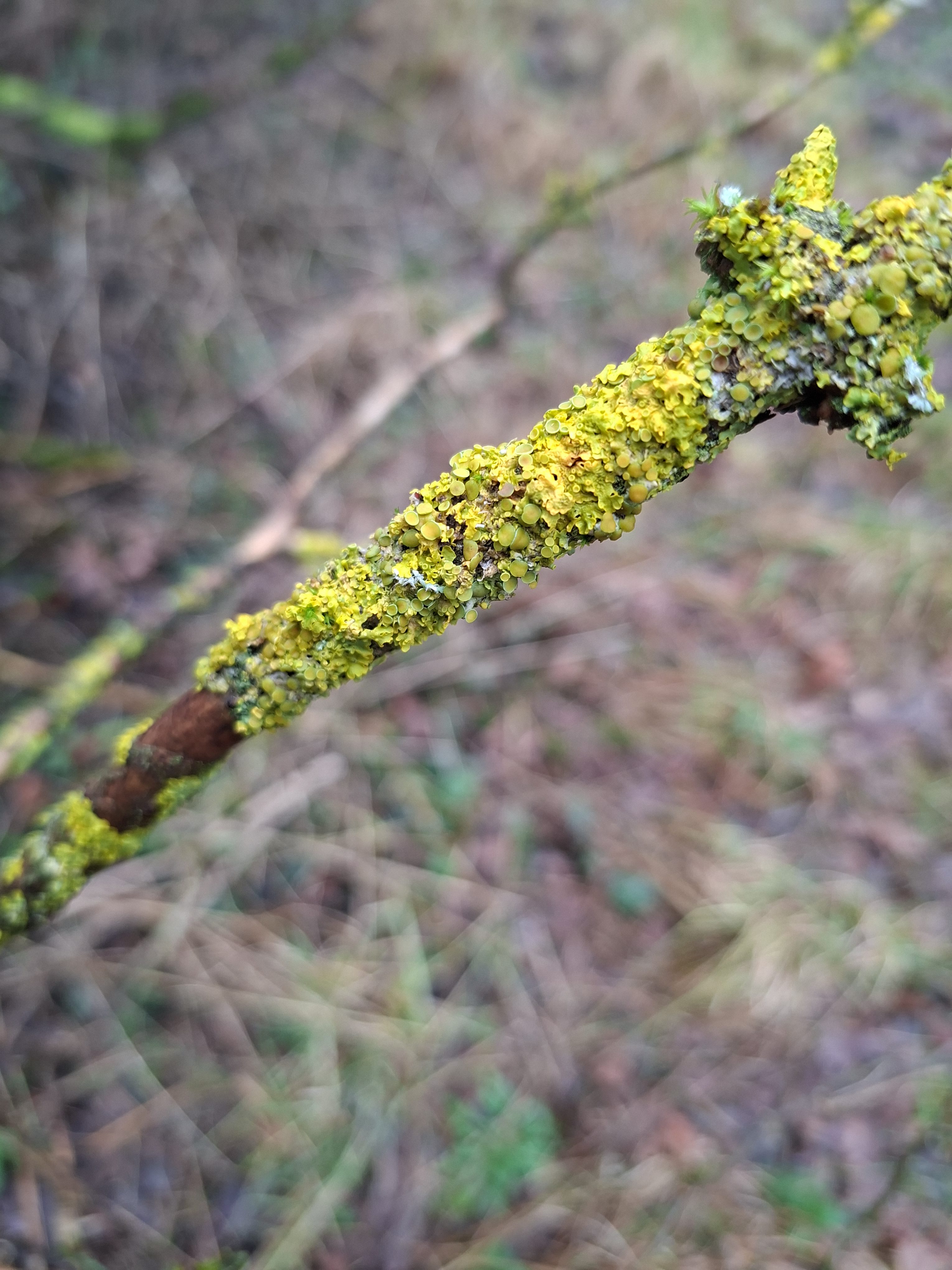
Common sunburst lichen (Xanthoria parietina)


The common sunburst lichen (Xanthoria parietina) is a lichen forming fungus from the Teloschistaceae family. Discovered by Carl Linnaeus in 1753. The lichen itself is made up of small, overlapped lobes that measure less than 10cm across, its color can vary greatly, ranging from vibrant greens to almost reddish orange, making it often appear with a kind of green-yellow gradient. The actual lichen is formed from a symbiotic relationship between a fungus and green algae, within which the algae is protected from UV and light by the fungus. In terms of habitat the sunburst lichen, uncharacteristically for lichens, can grow in a large variety of places or conditions, often being found everywhere from windblown coastlines, garden walls, trees, and even high pollution areas like cities and motorway infrastructure, unlike most lichens the sunburst lichen also reproduces sexually. Using cupped fruiting bodies with extremely high rates of spore release in the right conditions. Despite being slow growing the sunburst lichen is very resilient, often able to regrow completely from small fragments.
Uses and Folklore
The common sunburst lichen has been used in the past for its bright yellow, green and orange pigments, being used to dye textiles and color early paint, furthermore it is used in historical medicine to cure jaundice and related issues. It can also serve as a key environmental indicator, as it is capable of collecting particulate matter and pollutants, as I found out in the last year of my A-levels, where we conducted a sample of the lichen growing on the lamp posts near the college with sections of adhesive tape, and found that the closer the lichen was to the road, the more black particulate matter would accumulate on the surface of the lichen. Furthermore, the common sunburst lichen has been a pioneer for research into the biology of lichens, as well as astrobiology, as with recent testing it has been found that the sunburst lichen can survive extreme conditions such as cosmic radiation, complete vacuum and mars like conditions. Making it a fascinating study in the resilience of lichen.