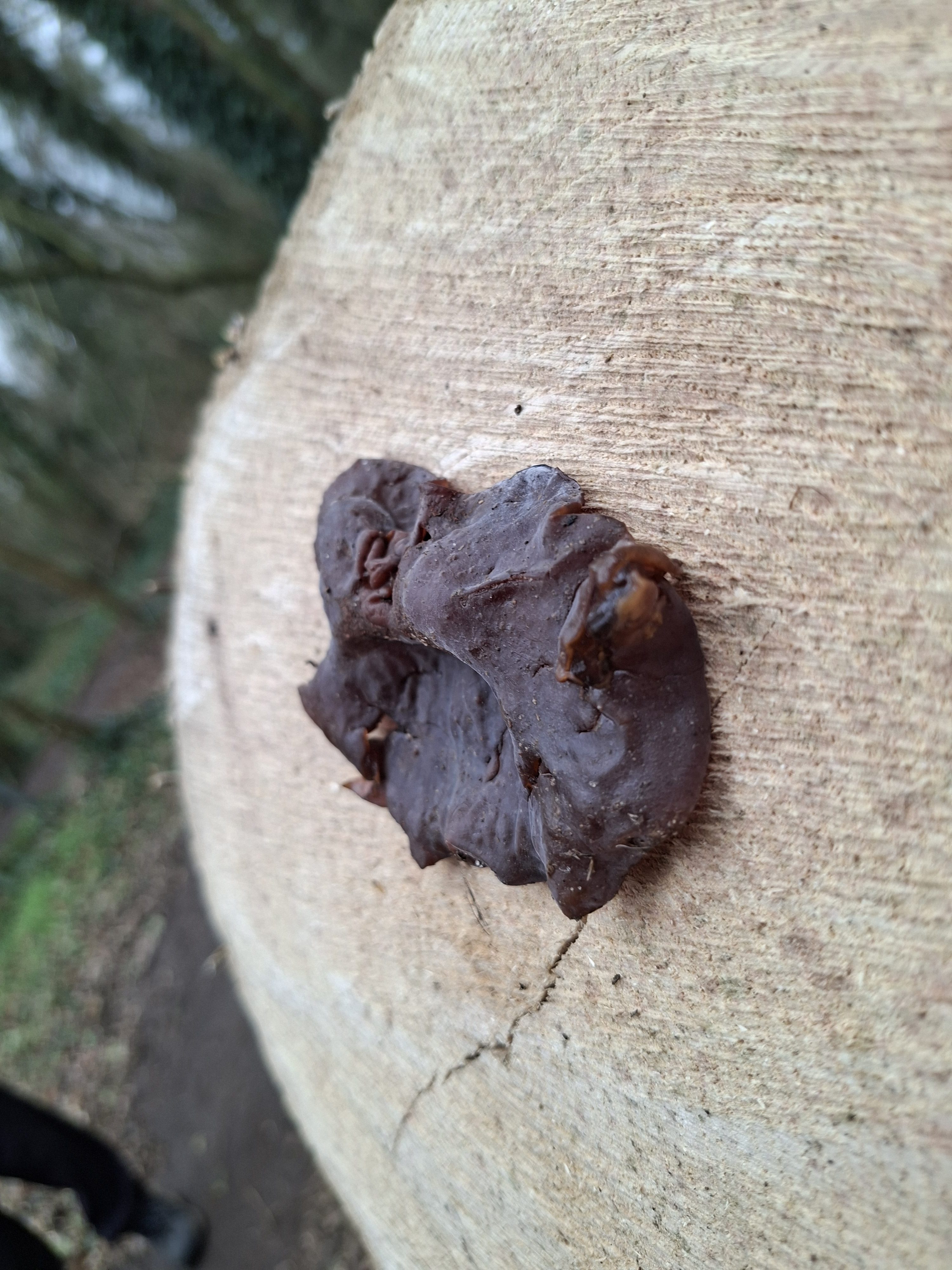
Jelly Ear (Auricularia auricula-judae)


Habitat and Identification
The Jelly ear fungus or Auricularia auricula-judae is a bracket fungus commonly found on dead wood and live hardwood like ash and beech, in particular areas that get little sunlight and have a high average moisture level, such as the undersides of tree branches, fallen wood and dead wood on the forest floor. The fungus itself is a type of jelly fungus that is ear shaped, often being various shades of brown, ranging from a light tan to an almost purple-brown hue, as seen in my images. The outer surface of the jelly ear is slightly velvety surface sometimes appearing wrinkled if the fruiting body is old, they can vary quite dramatically in size ranging from 2cm to up to 15cm. the inside of a jelly ear is shiny and gelatinous, hence its name. the underside of the fungus is riddled with fine, almost imperceptible brown gills that carry the spores, that are then released from the gills when they are disturbed by wind or impact, where they can be carried away by the wind, allowing for widespread seeding. When the fruiting body is very young the gills are covered by a very fine membrane that quickly falls away as the fungus grows.
Medicinal use and folklore
Jelly ear has been noted to be very popular among eastern European and Chinese food historically, still seeing use in China today as “wood ears” like most fungi and herbs they have seen use medicinally in as late as the 1800’s being used to allegedly treat poor vision, however I have found no records to back this up, however I did find out about a botanist/ herbalist John Gerard (1545-1612) who reported that boiling jelly ear’s in milk could provide an effective remedy for irritation of the throat, Gerard was a well recognised English botanist from Holborn and published “General Historie of Plantes” in 1597. (which was actually a mostly plagiarised copy of a book written by Rembert Dodoens, a Flemish botanist in 1554.) The jelly ear has rich roots in folklore and mythology, mostly due to the uncanny shape in which it grows, with many myths featuring it as the “ears of the woods” or with other references to its earlier name “judas ear” so named because it can be prominently found on elder, which is the same type of tree that judas hung himself from after the betrayal of Christ. Over time the name “judas ear” became “jew ear” and eventually was modernised to “jelly ear” as we know it today